Google may have just dropped its biggest AI clue of the year—and it wasn’t through a polished Keynote or a press release.
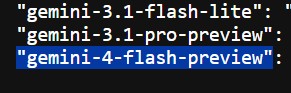
Eagle-eyed developers digging through Google’s public SDK repository spotted an unannounced string resting right in the tokenizer code: gemini-4-flash-preview.
The unexpected code reference directly links the unreleased model to Google’s next-generation Gemma 4 tokenizer family, providing concrete evidence that Google isn’t just experimenting with its fourth-generation architecture—it’s actively plumbing its public tooling to support it.
Key Takeaways
The Leak: Google’s tokenizer codebase explicitly references
gemini-4-flash-preview.Gemma 4 Link: The string is mapped to the new Gemma 4 tokenizer, indicating underlying architectural changes.
Tooling Ready: The leak suggests internal testing and developer ecosystem preparation are already well underway.
The Big Question: Will Google launch this model as Gemini 3.7 Flash first, or jump straight to a full Gemini 4 Flash release?
What the Code Actually Tells Us
In large language model development, tokenizers determine how text, images, and audio are broken down into processable units for the neural network. A tokenizer update usually signals fundamental changes to how a model handles context, efficiency, and multi-modal data.
The fact that gemini-4-flash-preview is explicitly mapped to the Gemma 4 tokenizer family points to two major conclusions:
Active Internal Testing: Google is running live benchmark or subagent tests against public SDK bindings.
Shared Architecture: Google continues to align its open Gemma model framework with its closed-source Gemini ecosystem, ensuring seamless cross-compatibility for developer toolchains.
While tech giants often hide placeholder strings in pre-release software, mapping a specific string to a new tokenization pipeline goes beyond simple code hygiene—it means production integration is already happening behind the scenes.
Gemini 3.7 Flash or Gemini 4 Flash: The Naming Dilemma
Google’s model versioning strategy has evolved rapidly over recent months. With incremental updates like Gemini 3.5, 3.6, and specialized sub-variants constantly rolling out, the roadmap isn’t entirely linear.
This raises an intriguing question: Is gemini-4-flash-preview purely an internal development codename, or does Google plan to skip ahead?
As highlighted in recent coverage by NokiaPowerUser, Google has been aggressively expanding its Flash lineup to lower inference costs and speed up agentic workflows. Depending on product strategy, Google could choose to package this architecture as a mid-cycle Gemini 3.7 Flash release to maintain marketing momentum, or officially unveil Gemini 4 Flash to showcase a true generational jump in speed and capability.
What This Means for Developers and AI Creators
Regardless of the final label on the API endpoint, the leak confirms that Google is prioritizing lightweight, ultra-fast frontier performance.
Lower Latency: Flash models serve as the backbone for real-time applications, mobile AI, and autonomous agent loops.
Token Efficiency: A updated Gemma 4 tokenizer suggests better compression and lower token usage costs per request.
Smarter Subagents: Next-gen Flash models are increasingly designed to handle specialized multi-turn reasoning without the heavy compute cost of Pro or Ultra variants.
Final Thoughts
Accidental SDK leaks are often the best indicators of what’s coming down the tech pipeline. By leaving references to gemini-4-flash-preview in public code, Google has signaled that its next big leap in lightweight AI is closer than expected.
Keep an eye on Google Cloud and Gemini API update logs—an official preview announcement may be right around the corner.