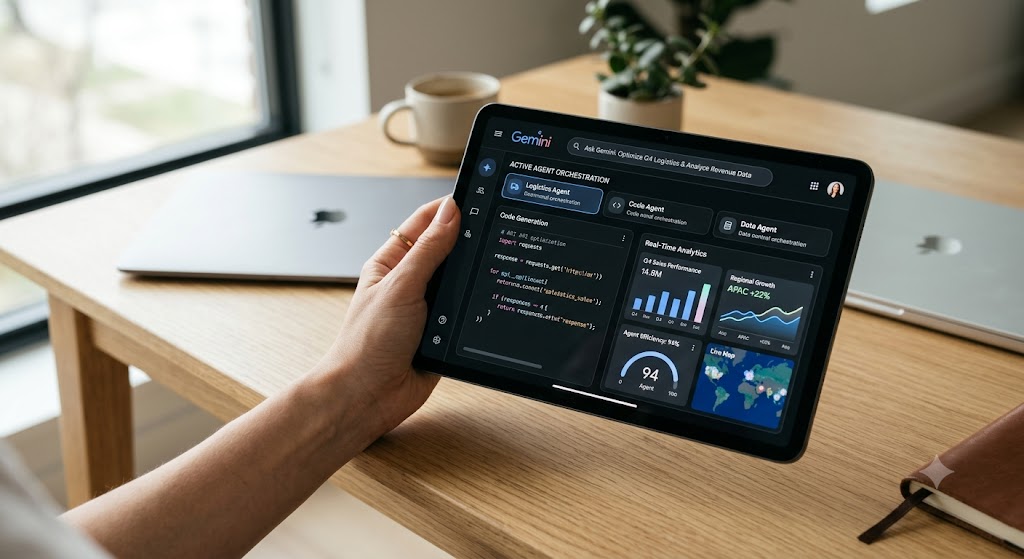
At Google Cloud’s Gemini at Work event, Google officially announced Gemini as a single universal agent for work. Designed to eliminate platform fragmentation, this next-generation agent connects to your entire enterprise business context, taking users from basic queries to complete task execution through a single prompt box.
Rather than managing dozens of disconnected point-solution tools, organizations can delegate multi-step projects—spanning knowledge work, data analysis, image creation, and software development—to one intelligent, persistent enterprise co-worker.
For more coverage and breakdown on the latest enterprise artificial intelligence breakthroughs, explore NPoweruser.
Key Architectural Principles Behind the Gemini Agent
Google Cloud built the universal Gemini agent around six core architectural pillars engineered for performance, security, and cost-efficiency:
| Architectural Pillar | Enterprise Capability |
| Unified Agent | Operates from a single prompt box to answer questions, handle complex knowledge tasks, generate creative media, and write or run code autonomously. |
| Universal Access | Web-based and accessible across any device, integrating directly into tools like Google Workspace, Microsoft 365, and Slack, or running headless via API. |
| Persistent Execution | Runs on secure cloud infrastructure to maintain a unified memory graph, continuous work context, and personalization across all devices. |
| Multi-Agent Orchestration | Spawns specialized sub-agents for complex workflows or operates as a dedicated co-worker agent with its own identity, corporate email, and directory presence. |
| Deep Business Context | Learns work history, organizational tools, and processes over time while adhering to existing data permissions and enterprise governance. |
| Model Choice Flexibility | Dynamically routes tasks across multiple models (including Anthropic’s Claude alongside Gemini) to optimize response quality and minimize token spend. |
How Gemini Redefines Everyday Enterprise Workflows
1. Unified Interface and Seamless Integration
Instead of jumping between disconnected AI assistants, employees use one entry point. Whether you need to draft a marketing brief, inspect a database, or push code, the agent handles the task from the same window with consistent context. It works inline within everyday tools such as Gmail, Docs, Sheets, and third-party software environments.
2. Autonomous Task Execution and Delegation
When given an objective, Gemini works asynchronously on Google Cloud infrastructure. If you assign a multi-step project—like gathering data, building a spreadsheet model, and generating a pitch deck—Gemini completes the execution end-to-end even after you log off for the day.
3. Dedicated AI Co-Worker Identities
With multi-agent orchestration, organizations can assign specialized co-worker roles. A sub-agent can receive its own @company.com email address, Calendar, and Drive storage. Team members can simply @mention the agent in Chat or tag it in documents to collaborate as they would with a human colleague.
4. Smart Model Routing and Granular Cost Controls
Enterprise leaders can govern AI usage using the Agent Gateway. Smart Routing routes routine requests to lightweight models and reserve high-tier reasoning models for complex engineering or analytical queries. Administrators can also set project-level spend caps, automatically pausing agents if budget thresholds are met.
Today at Google Cloud’s Gemini at Work event, we announced Gemini, a new single universal agent for work that has all of your business context and can be used for everything from knowledge work to answering questions, and content creation to coding, all from a single prompt box.
It’s built around core architectural principles:
☑️ Unified Agent: Gemini can answer questions, do knowledge work and generate code from a single prompt box.
☑️Access: Gemini is web-based and can be accessed from any device and integrated into third-party applications. It can also operate without a dedicated user interface.
☑️Persistent Execution: It runs in the cloud, which means it maintains a single set of memories, context and one personalization graph no matter where you access it.
☑️Multi-Agent Orchestration: Gemini can create sub-agents to tackle multi-step tasks and can also act as a coworker agent with a defined role and its own dedicated identity
☑️Context: Gemini knows your tools, data, and work history and learns how you work the more you use it.
☑️Model Choice Flexibility: It orchestrates across multiple models to deliver optimal quality and lower your costs.— Thomas Kurian (@ThomasOrTK) October 8, 2026