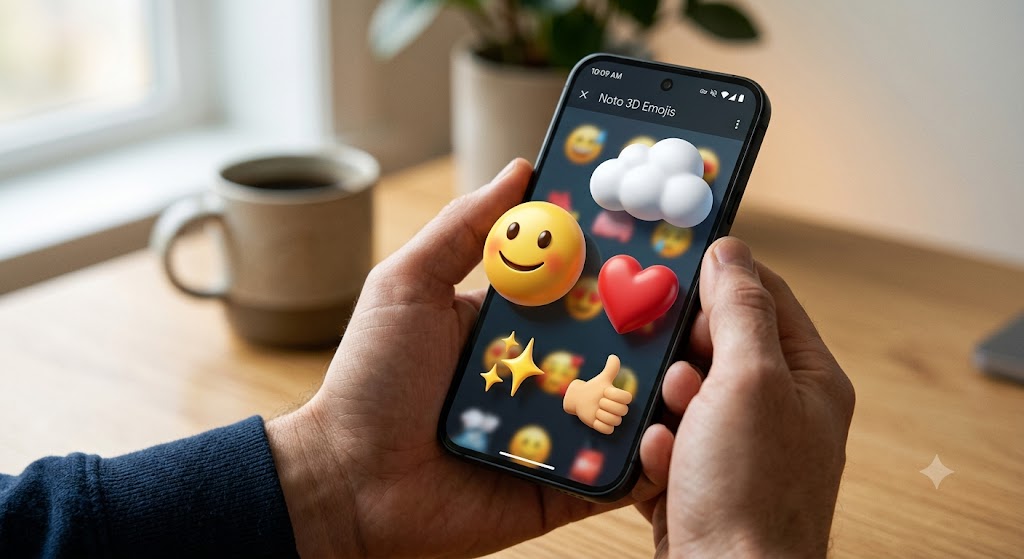
Emojis have become the default punctuation of modern messaging. We use them to drop quick context, signal sarcasm, or send a warm sign-off without typing a single word. Now, Google is giving these digital staples a massive visual upgrade by bringing Noto 3D emojis to Android devices and partner ecosystems.
The update transforms thousands of classic, flat Unicode symbols into rich, dimensional models. Instead of replacing the character of the original designs, the new 3D system preserves the playful, recognizable identity of Google’s Noto emoji family while introducing subtle lighting, depth, and material layers that make them feel tangible.
In a live chat, ending a sentence with a period reads like an act of aggression. That’s just the emotional tax of talking through glass. To bring real warmth, bounce, and presence back to the screen, we’re rolling out Noto 3D.
Go behind the scenes with @jenniferdaniel to see… pic.twitter.com/X0CsJuH3Bj
— Google Design (@GoogleDesign) September 17, 2026
Expanding Beyond Pixel: Broad Android Availability
While major visual overhauls often stay exclusive to Google’s flagship Pixel lineup for months, the Noto 3D rollout is reaching across the broader Android ecosystem right out of the gate.
Device manufacturers integrating the updated 3D design set include:
Pixel Series
Nothing
OnePlus
Motorola
Xiaomi
Lenovo
OPPO, realme, and vivo
HONOR
To make adoption seamless for third-party developers and designers, Google has also released the raw models in the open-source Google Fonts repository. This open approach allows app creators to bring consistent 3D emoji assets into cross-platform UI, web apps, and custom chat clients without building assets from scratch.
Crafting the Third Dimension: Design Challenges
Transitioning thousands of flat vectors into three-dimensional models isn’t as simple as slapping a shadow behind a circle. Google’s design team, led by visual designer Jennifer Daniel, faced unique creative and technical hurdles during the conversion process.
+-----------------------------------------------------------------------+
|                       Key Design Challenges                           |
+-----------------------------------------------------------------------+
|  1. Anatomical Fixes      | Corrected vector flaws (like a poodle's   |
|                           | extra leg) during 3D conversion.          |
|  2. Full 360 Modeling     | Imagined unseen angles, such as the back  |
|                           | side of iconic round smileys.             |
|  3. Micro-Scale Clarity   | Balanced rich textures with high legibility|
|                           | at tiny, inline text sizes.               |
|  4. Dynamic Dark Mode     | Adjusted edge contrast and bounce light   |
|                           | to keep icons crisp on black backgrounds. |
+-----------------------------------------------------------------------+
The Unseen Angle Problem
In 2D, a smiley face is just a flat yellow disc. In 3D, it becomes a distinct geometric volume. Designers had to figure out what the back and sides of these iconic shapes looked like without making them look unnatural when rotated or animated.
Cleaning Up Legacy Art
Translating flat art into 3D models exposed long-standing legacy quirks from old vector files. One notable fix involved an extra leg on the original poodle emoji—an artifact of stacked vector paths that only became obvious once turned into a full mesh.
Small-Screen Legibility
Emojis spend most of their lives tiny, squeezed inline next to 14-point body text. If a 3D model features too much surface noise or complex texturing, it turns into an unreadable smudge on a phone screen. The design team adjusted edge highlights, specular reflections, and ambient shadows so every icon pops cleanly—whether viewed on a compact 6-inch phone or a large tablet display. Dark mode compatibility also required tweaking lighting maps to keep dark or translucent emojis visible against pure black backgrounds.
What This Means for Everyday Android Users
The shift to 3D emojis reflects a broader design trend across consumer tech: moving away from ultra-flat interfaces toward tactile, soft-depth aesthetics (often called “flat-round” or soft 3D).
Because the open-source files are available in Google Fonts, expect to see these dimensional icons pop up beyond standard system keyboards. Chat platforms, productivity apps, and web interfaces will soon feature a unified, expressive visual language across the entire Android landscape.
Interested in reading more about Google Pixel smartphones. Read our full Google Pixel coverage by clicking here.
Please follow us on our Facebook page and X account for all latest and breaking Google, Android and Nokia related news